Last night my family and I went to see The Hobbit. It was a fairly big deal – we’ve not been to the cinema together since Prince Caspian (sensing a theme?). I love the humour of The Hobbit’s narration and knew the film would raise some laughs but was intrigued to see how they‘d stretch the story out over 3 full length films.
And that was the sticking point; I couldn’t shake off the sense of the story having been over-stretched. I tried to sit back and enjoy it- but I couldn’t ignore the fact that it took over half an hour for Bilbo to leave his hole. As enjoyable as the dwarf songs and slapstick humour was, it ruined any chance of Bilbo’s exit feeling rushed. His panic is integral to the story, and without it the plot lost momentum and purpose.
The action scenes were drawn out and shot so quickly as to mostly be a blur. I’m pretty certain my Dad dozed off for the majority of the fighting scenes without missing much of the plot. As he pointed out, with the exception of the tree/wolves scene, there’s very little character development that takes place during the high-adrenaline scenes.
It felt like the story was being moulded into a cookie-cut adaptation in order to appeal to an imagined, short attention-spanned audience. Peter Jackson doesn’t pull it off because the fighting scenes are so frequent and drawn out that they loss their tension. It’s blinding clear that all the characters will pull through. I can't help thinking that newcomers to the story will lose interest and Tolkien fans will only notice the inconsistencies.
I won’t pretend I'll avoid the next two films, but I’m not convinced they’ll be worth the admission cost. It’s ironic that a film about greed has been ruined by an attempt to prioritise revenue over quality. Yes, The Hobbit is a jam-packed book to adapt. But dragging it out over 3 films has meant a lack of direction, tension and purpose. Not to mention losing that satisfying sense of a story well told. This hobbit is unimpressed.
30 December 2012
4 December 2012
The Night Circus by Erin Morgenstern
The Night Circus arrives without warning. Yesterday there was a bare field, today there is a circus. Nobody knows where it came from or how it arrived. Everything about it is a mystery, even to the performers. Opening only at dusk, the Night Circus attracts droves of customers like moths to a flame.
To those watching, the performers seem to be perfectly in control. They perform their acts with ease and charm their audiences. But beneath the polished acts lie dark secrets. Chosen as the venue for a dark challenge between two young magicians, the fate of the circus is tied to their fate.
Demonstrating their skill, each player begins to to make intricate additions to the circus. As the connection between them strengthens, the pressure of the duel begins to take its toll on the circus. Suspended in this unearthly game, the circus members begin to lose touch with reality. When will the challenge end? Who will be declared winner, and what will this mean for the circus?
This is such a delight to read. The imagery used jumps right out of the page, until you almost feel like running off to the circus yourself. Erin Morgnestern conveys such a physical impression of the circus that despite the supernatural events the circus seems touchable, real. Her knack for using myriad details and weaving these together continuously throughout the book must have taken an impressive amount of planning.
The best thing about the novel was the way in which the circus kept growing, kept being discovered. Each new tent is described with such originality and freshness. Here's one of my favourites, The Cloud Maze:
'The tower itself is a series of platforms swooping in odd, diaphanous shapes, quite similar to clouds. They are layered, like a cake. From what Bailey can see, the space between layers varies from enough to walk straight through to barely enough to crawl. Here and there parts of it almost float away from the central tower, drifting off into space.
And everywhere, there are people climbing. Hanging on edges, walking through paths, climbing higher or lower. Some platforms move with the weight; other seem strong and sturdy. The whole of it moves constantly, a light movement like breathing.'
Part of the reason Erin Morgnestern is able to conjure up the circus so vividly is that we view it through so many different eyes. We're pulled along by the playful twins Poppet and Wiget, guided by their awestruck new-found friend Bailey, and educated by the detail-loving, clockmaker Friedrick Thiessen. All these experiences combine until the circus becomes the most concrete and known character of the book.
This concentration on the setting and the episodic structure of the chapters, which switch between scenes and time periods, meant that I couldn't quite get a hold on any of the main characters. Some disappear for pages and pages, only to surprise me with how little I missed them on their return. But maybe that's not a bad thing. There is so much else to concentrate on in this book, so many senses being evoked that I was left with only scant attention to pay the characters.
What was unmissable was the tension between the two dueling magicians. Erin Morgnestern builds up the chemistry between these two until it's almost unbearable. I loved it, and I'm not ashamed to admit it.
This is a fantastic, inspiring read that'll worm its way into your head.
27 November 2012
Me Before You by JoJo Moyes
Life affirming isn't a phrase you'd expect to describe a novel about a quadriplegic fighting for his right to die, but it fits in this case. Me Before You is a dangerously compelling account of the relationship between a paralysed former city slicker and his inexperienced but resolutely chirpy carer.
Lou Clark never set out to become a carer. In fact, most of what's happened to her over the last few years has been unplanned. Her sister is the one with the big plans for university and beyond, Lou just...drifts. So when her priced job at the lively Buttered Bun tea shop comes to a sudden halt Lou's options are scarce. Threatened with losing her unemployment benefit, Lou applies for the 6 month care position in a local wealthy private home.
Embittered by his constant discomfort, pain and poor quality of life, Will Traynor is initially irritated by Lou's naivety and her eager attempts to please. Within a matter of weeks however, they begin to warm to one another and develop an engaging and authentic dialogue.
'It's not the bloody carrots that upset me. It's having them sneaked into my food by a madwoman who addresses the cutlery as Mr and Mrs Fork.'
'It was a joke. Look, let me take the carrots and-'
He turned away from me. 'I don't want anything else. Just do me a cup of tea.' He called out to me as I left the room, 'And don't try and sneak a bloody courgette into it.'
Nathan walked in as I was finishing the dishes. 'He's in a good mood,' he said, as I handed him a mug.
'Is he?' I was eating my sandwiches in the kitchen. It was bitterly cold outside, and somehow the house hadn't felt quite as unfriendly lately.
'He says you're trying to poison him. But he said it - you know - in a good way.'
I felt weirdly pleased by this information.
The interaction between the two main characters is the bloodline of this story. It's what kept me reading until 3am one night. JoJo Moyles has created two such bright, lifelike characters that they seem to exist outside of the page. Even after I'd finished the book, I could easily still conjure them up. I started imagining different scenes without intending to, so strongly are their personalities and characteristics painted. This is a book which is very hard to shake off.
It wasn't often laugh-out-loud funny, but there are many light moments and the constant sparring between Lou and Will made for a humourous read. There's something of classical Hollywood in the way that their insults bounce off each other and bring them closer together (I'm trying so hard to avoid the word banter here). There were other characters, some more worthy of note than others (Lou's tumultuous, loving family spring to mind) - but to be honest they paled in comparison to the vividness of Lou and Will.
The concentration on their relationship keeps Will's paralysis from being the be-all-and-end-all of the novel. It's an issue which is still in focus, but it's weaved naturally into the comings and going of their everyday lives. Plus, Will is such a strong character that it's impossible to define him by his condition.
There's a lot of sadness in this book, but it's not the instant tear jerker that the synopsis might suggest. The novel has a lot more depth to it than that. If I had any criticism it would probably be that it's too easy to read, and that the plot was so compelling that I ended up rushing hastily towards the end instead of savouring it. Enjoyable, heartwarming and authentic.
19 October 2012
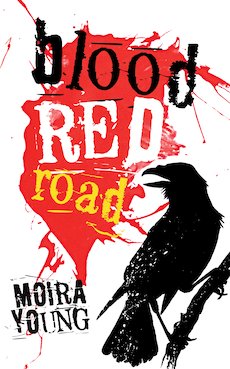
Blood Red Road by Moira Young

Beside a dried up lake in a futuristic, dusty world live a family of four. A bitter father, withdrawn since the loss of his wife, two grown twins, Saba and Lugh, and the lively nine year old Emmi scrape out an existence. With their father still immersed in grief, losing his head in the distant stars, Saba and Lugh are forced to battle the desert conditions to keep the family alive.
In their eighteen year, the restless Lugh begins to dream of leaving the dead-end farm. When their father is shot dead trying to stop a mysterious gang from capturing Lugh, Saba vows to track them and rescue her twin brother at all costs. Accustomed to following Lugh like a shadow and distrustful of others, Saba is determined to find him alone. Despite her lack of social graces, Saba's knack for picking up friends means that she unwittingly becomes the leader of a rebellion.
For a petulant king rules this world with a vice-like grip. Previously unchallenged, he crushes resistance with a steady supply of a sedative-like drug and the blood-thirsty spectacle of cage fighting. Fixated with the need to find her brother, Saba couldn't care less about the King. That is, until he gets in the way of her search. And though he might not know it yet, Saba is not the type of woman he should get in the way of.
*************************************
I'm sure it's not just being in the U.S this week that's making me draw comparisons between this YA action-packed novel and the Western genre. The dry, arid setting, horses, the theme of leaving a homestead, duels with 'shooters' and puffed-up gang-like leaders with hired lackeys. It's a quality which differentiates the book from the ever-present 'Hunger Games', which it's often compared to. Like many apocalyptic stories, the futuristic setting resembles more closely an older world to that we live in. The lack of modern convenience and communication in Saba's world has made her grow self-sufficient and tough-both qualities popular to young adult fiction. The author's also created a landscape which lends itself really well to an old-fashioned adventure, with hugh rocks, sandstorms, mountains and flash floods.
Saba is an opinionated protagonist with a big personality and a strong will. The characters and events she's thrown amongst during the course of this tale force her to question her opinions and actions, but the author doesn't spend a great chuck of prose on these revelations. Instead the change in Saba is shown by the way she responds to the various challenges she's faced with. Without the stalwart support of her twin brother, she ends up initiating new friendships, slowly opening herself up to the idea of relying on others. So there's a fair bit of character development going on here and Lugh's absence in the story is central to this. Whilst I can see the motivation for this, I couldn't help thinking that story could have been richer and fuller if it had also been told from Lugh's point of view.
My only other bug-bear was the style of writing. The lack of punctuation left me confused as to who was speaking and I was baffled by Saba's intermittent italicsised monologues. The kooky spelling and childish grammar means that Saba's voice is distinct and strong, but it felt a little twee at times.
That being said, the prominence of this style faded as I got pulled deeper into the story, and the self-conscious poetic element of the first few chapters was replaced by drawn-out action and suspense-filled chapter endings. I was also captivated by the sexual underpinings of Saba's interactions with a wandering rebel named Jack and the dark, brooding guard to the king, DeMalo. Moira Young recreates perfectly the insecurity, excitement and fear involved in an adolescent crush. It's fairly clear from the book's end that Young has written this with a sequel (if not a trilogy) in mind. Whilst this means that the ending can't truly be described as satisfying, I can comfort myself with the fact that Saba's likely to turn up again soon.
Labels:
Blood Red Road,
Children's fiction,
Moira Young,
Review,
YA
10 October 2012
Subscribe to:
Posts (Atom)