23 September 2012

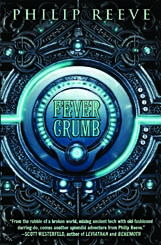
Fever Crumb by Philip Reeve‏


Fever Crumb by Philip Reeve‏Fever Crumb has been born into a futuristic world still reeling from the overthrow of the ruling Scrivens (or 'homo superior' as they like to term themselves).

This is London; but not as you know it. Commuters carry Oyster shells, instead of cards, and travel by wind tram or sudan chair. What we call modern society was destroyed by a dark period referred to as the ‘downsizing’; hence most of outer London consists of empty buildings and overgrown, useless roads. Technological advances such as flight and electricity have been lost and anyone with an interest in science is considered odd. The violence of Scriven rule is still fresh in the minds of Londoners and the city is buzzing with distrust and mutiny.

A small corner of reason remains in an abandoned monument. In a head constructed to represent the former Scriven king Auric Godshank, a band of engineers reside. Protected from the mayhem of the city they quietly beaver away at their experiments, rejecting any form of emotion as a distraction. An anomaly in a society of men, Fever Crumb was found abandoned as a baby and subsequently raised by a kind engineer named Dr Crumb.

Having been brought up in a reasonable manner, the young Fever Crumb reacts calmly when she is required to leave the engineers to assist the kooky archaeologist Kit Solvent. Solvent's rag-tag children and quirky ways baffle Fever Crumb. But that's nothing compared to the bizarre illusions Solvent's work seems to evoke in her. She's left frightened by her reaction to a visit to Godshank's former residence:

"Try the door,' said Kit, and held his lantern up to light the lock.

Weird feelings of déjà visité flooded through Fever. Memories of yesterday mingled with memories of other yesterdays which could not possibly be her own. Pain was beating again at the base of her skull. She began to wonder if she were still inside her dream. If she climbed the stairs again and went outside would there be lights in the unbroken windows of Nonesuch House?"

The city grows more and more restless as Fever begins to question her own sanity. Soon her piercing odd eyes and unusual manner evoke aggressive suspicion from Londoners. 'What are you?' is the constant refrain that Fever herself cannot answer. Why does she appear to have memories that she doesn't own? What is Kit Solvent hiding from her? And can he keep her safe from the unruly and angry crowds?

                                                  ************************************

This was my first Philip Reeve read, but I’m certain it won’t be my last. I really admire his ability to create such quirky, intriguing scenarios and characters. He plays with your familiarity of London with places names such as ‘Hampster Heath’, ‘B@ersea’, and ‘Eefrow’ and hints at religious legends involving the worship of prophets such as ‘some old-world prophet, ‘Hari, Hari! Hari Potter!’Such details make up part of the intricate world that Reeve has created. Reeve shows a delightful interest in building the world of this Mortal Engines series, layer by realistic layer. Without having to take in much detail, as the novel plays out you naturally absorb a sense of the workings of the setting.

Fever Crumb, Dr Crumb and Kit Solent are all fresh, likeable and fleshy characters with believable quirks and motivations. The dialogue moves the plot along and also provides countless moments of humour. I especially loved how the pantomime-like villain Ted Swiney was drawn:

"Ted Swiney suddenly reached across the bar and lifted him up by his coat collar. His amiable act had ended. He growled softly into Charley’s ear. ‘Anything the old cloot finds, I want to hear about it. You understand?’

Charley nodded eagerly, and Ted dumped him on the floor, grinning round at his customers to show he’d just been having a bit of harmless fun with the boy. His smiling cheeks were red and round as two wax apples. He leaned over the bar to straighten Charley’s coat and pat his hair flat. ‘Now hop along. Don’t keep Master Creech waiting."


Clearly a lover of language, Reeve has created for characters such as ted Swiney a winsome fusion between cockney and 21st century text-speak. In short, this is a multifaceted, fast-paced, charming novel that has plenty to tempt older readers, young adults and the young-at-heart.

11 September 2012

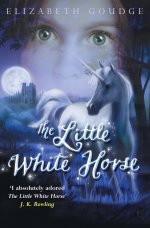
The Little White Horse by Elizabeth Goudge


The Little White Horse by Elizabeth Goudge

13-year-old Maria Merryweather has an uncanny knack for making friends. Almost everyone she meets in this old-fashioned tale falls for her frank and cheerful nature and boundless energy. Uprooted from her luxurious London home after her father's death, Maria, her governess and their pampered pooch are forced to seek refuge with her strange, distant relative Sir Benjamin Merryweather on the windbeaten coast of the West Country. Despite her faults (she's headstrong, argumentative and vain), Maria's charm soon sees her surrounded by a protective circle of adult and animal guardians. It's well she is, as the magical residence of Moonacre is not as idyllic as it first appears.

Maria soon begins to unweave the secrets of Sir Benjamin Merryweather's picturesque residence. But the facts of the past still evade her. How did her childhood friend Robin come to be here? Who was the mysterious woman that last slept in her room and rode her horse? Who are the dark men that stalk the nearby wood and deny the village access to the sea?

Published in 1946 and set in 1842, The Little White Horse merges legend, magic and adventure with old-fashioned morals and lashing of afternoon tea. The folklore influence and the inclusion of eccentric characters such as the ferocious chef Marmaduke and his all knowing, literate cat Zachariah, add to the offbeat feel of the book. Despite this originality, Elizabeth Goudge‏'s description of the landscape, the village and Maria's interactions with her beloved friends come across as a trifle twee. The benevolent Old Parson springs to mind, instated in his picture-perfect cottage, tending lovingly to his flock. Helpfully, after each Sunday service the Vicar stands at the door of the church ready to reveal and reprimand each villager's sins. It's hard to tell how a 1940's child would read this but it struck me as overtly sanctimonious and judgmental.

 Despite Maria's strong influence over the residents of Moonacre, she's often scolded for not acting as submissive as her gender dictates. It's incredibly frustrating to read! Seen through a modern day lens, Maria's childish brand of feminism grates - especially as she's considered old enough to marry. The implication seems to be that girls, women and brides should be suspended in a state of ignorant innocence. The Old Parson vehemently enforces this view whilst holding Maria in a 'grip of steel'. He advises, 'excessive female curiosity is not to be commended either. Nip it in the bud, my dear, while there is time.' Whilst it could be argued that Elizabeth Goudge‏ is accurately representing 1800 opinions, this view of femininity is repeated often enough as to be deliberate.

That all being said, Maria is ultimately a decisive, outgoing character. Her natural curiosity, sense of humour and passionate temper keep her from coming across as sanctimonious. In The Little White Horse Elizabeth Goudge has created a beguiling set of characters, and set them in a charming, idyllic English countryside with an intriguing and magical plot.

2 September 2012

Fly By Night by Frances Hardinge


Fly By Night by Frances Hardinge

'Words were dangerous when loosed. They were more powerful than cannon and more unpredictable than storms. They could turn men's heads inside out and warp their destinies. They could pick up kingdoms and shake them until they rattled. And this was a good thing, a wonderful thing...'


Frances Hardinge's debut novel draws us into a dark, eighteenth century inspired society rife with highwaymen, rival royals, thieves, and one very aggressive goose. Amongst all this pandemonium lies a plucky young girl named Mosca Mye. Unlike the majority of her female peers, Mosca was taught to read by her father before he died. Now 12 years old and fiercely independent, Mosca is determined to leave her callous Aunt and Uncle and the damp, claustrophobic village in which they live. Having been mesmerised by the verbal dexterity of a travelling storyteller and conman named Eponymous Clent, Mosca rescues Clent from the clutches of the local magistrate and together they flee the village.

It's the beginning of an unlikely partnership, based more on the desire to keep alive than out of loyalty. Mosca's decision to hedge her bets with Clent, despite being aware of his slippery tongue and nature, shows her willingness to disregard social expectations in the pursuit of knowledge. Her love and respect for books is matched only by her affinity to Saracen, the goose that aided her escape from the village. Mosca senses the force of words and knowledge, and she thirsts after the power and freedom that they offer. What Mosca doesn't anticipate is the far-reaching consequences of her search. Together, Mosca and Clent tumble through a madcap series of events, eventually coming to the attention of the very highest, powerful members of their society. 

The plot winds unexpectedly, as does Mosca's loyalty and trust of those she meets. As a reader, this kept me constantly on my toes. Hardinge refuses to install any sort of absolutes in the novel, other than that of the desirability of free speech and education. This makes Fly By Night a refreshing intelligent, multifaceted young adult novel. There's a fair bit of humour to be found in her writing too, much of which is caused by her penchant for kooky names. She pokes fun at religious rites with her description of devout offerings: 

'They were passing a cluster of shrines. As she watched, a troop of grateful citizens trooped past the shrines, dropping different thanksgiving offerings before each icon. A biscuit for Goodman Blackwhistle. A mackerel for Goodman Sussuratch. A shiny coin for Goodman Greyglory.' 

Far from just religious-bashing however, Hardinge also intelligently dissects power, greed and the desire to crush dissent in politics, trade unions, and the royalty. This is a true gem of a book. Read it!

20 August 2012

Moonfleet: A classic tale of smuggling, based on the novel by J.M Falkner (Usborne Young Readers series)

Moonfleet J.M Falkner (Usborne Young Readers series)
This dark tale explores the 18th century world of Britain's seaside smugglers. Adapted to form a chapter book for young readers, the book is illustrated with charming pencil sketches by Alan Marks. I don't make a habit of reading chapter books as they fall into that middle ground between easy-to-read picture books and all-too-easy-to-love young adult fiction. But something about the whimsical title and the muted style of this cover caught my eye.

The story features the young John Trenchard and describes his foray into the secret world of smuggling. Whilst not naturally crooked, circumstances contrive to lead John into a life of crime and he is soon forced to take to sea to avoid capture.

I can remember as a child being spellbound by the incredible tales set around the sea, like the famous five's smuggling adventure and that Swallows and Amazons where the children sailed out to sea by mistake. It was as if there was something about the incessant pull of the sea that attracted adventure. For a landlocked child, the sea will always represent freedom and the danger it presents only increases its appeal.

Rob Lloyd Jones has made Moonfleet accessible without attempting to update the tale. By staying true to the original the book retains an air of archaic charm, gently drawing the reader in to that period. There's enough intrigue, crime and danger to spark the interest of even reluctant young readers, although the strong moral running through the tale could offset this. Against the strong plot, the young narrator fades away somewhat, probably due to his indistinct personality and unquestioning acceptance of the bizarre situations he finds himself in. To be fair, the age of the intended audience does explain the simplification of John's character but even so, his actions and thoughts sometimes came across as wooden and illogical. This is nothing compared to the one-dimensional representation of his love interest, the ever-patient and forgiving Grace, who is barely able to speak for herself at all.

Although this tale does have charm, I thought the narrative style could have been much more engaging and the dialogue more natural. However, the illustration style felt refreshing - perhaps because I'm new to the age range - but I felt that the sketches made for intriguing character representations with hazy, hard-to-read expressions.  I'm sure the smuggling theme would hold appeal for young readers and there are twists and turns enough keep competent readers interested.

15 August 2012

StoryCloud: The Hoopoe Bird by Emma King and Ross Collins


StoryCloud
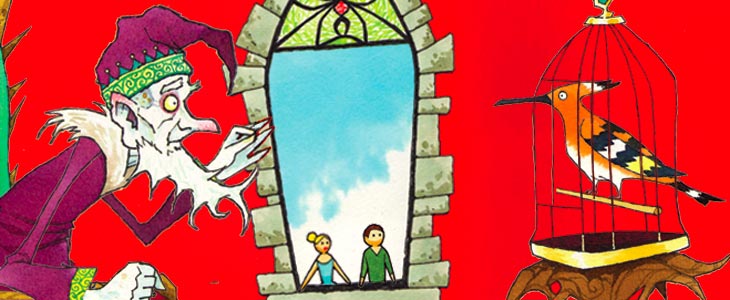
Illustration by Ross Collins
 Browsing through the Discover Children's Centre website tonight I happened upon the StoryCloud project, an online interactive library created especially for the London Festival 2012.


Here's the site's description: 

StoryCloud is an online story library featuring twelve brand new exclusive stories from award winning and up-and-coming authors and children. Each story is accompanied by a brilliant illustration. A new story will be released each Monday of the Cultural Olympiad until 3 September. The ninth story is now live, The Hoopoe Bird by Emma King and illustrated by Ross Collins.

The Hoopoe Bird is a simple little tale about a cruel magician and an exotic bird that he holds captive. Caught by the magician after a bold rescue mission during which some half-starved dolls are set free, the Hoopoe is chosen to star in the magician's performance show. But the Hoopoe bird has other ideas, and refuses to sing. What follows is a battle of wills between the man and bird.

It's a short and to-the-point tale with few major twist or turns and a strong overall moral. But what really sets this story about is its method of telling.

The story comes to life in the mouths of the fantastic child narrators on the available audio track. They bring warmth and depth to the tale with their tone and timing, and humour through the emphasis on words like 'dark' in the opening line, 'there was once a evil magician who did dark magic.' Whilst the style and tone of their delivery mimics traditional storytelling, the simplicity of the story kept the experience fresh.

I say they because I found it difficult to tell how many different voices I was hearing. There's something automated about the audio production that echoes the text-to-speech Kindle voice, and it certainly sounds like the recording has been heavily edited.

But there was still something about the actual process of being read to that really captivated me. It reminded me of Dr Jane Davis' essay 'The Reading Revolution' in the Stop What You're Going and Read This Vintage collection, where she describes The Reader Organisation's Get Into Reading programme as a 'read-aloud' group. In this essay, Davis describes how magical the process of reading literature aloud can be. She recalls being unexpectedly handed an emotive poem to read in a meeting, 'John had handed me some sad powerful magic, and I'd set it off by reading it aloud, a sort of spell.' It's a beautiful way of pointing out what we lose when we stop being read to as children. 

The Get Into Reading read-aloud groups are primarily focused on bringing the restorative aspect of communal reading to children, the elderly, youth groups, office workers, the mentally ill and many more. (You can find out more here: http://thereader.org.uk/get-into-reading/