19 October 2012

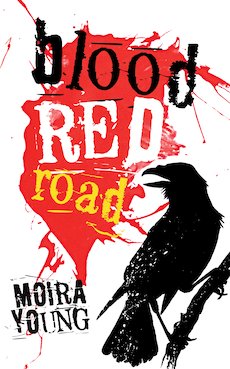
Blood Red Road by Moira Young

Blood Red Road by Moira Young

Beside a dried up lake in a futuristic, dusty world live a family of four. A bitter father, withdrawn since the loss of his wife, two grown twins, Saba and Lugh, and the lively nine year old Emmi scrape out an existence. With their father still immersed in grief, losing his head in the distant stars, Saba and Lugh are forced to battle the desert conditions to keep the family alive.

In their eighteen year, the restless Lugh begins to dream of leaving the dead-end farm. When their father is shot dead trying to stop a mysterious gang from capturing Lugh, Saba vows to track them and rescue her twin brother at all costs. Accustomed to following Lugh like a shadow and distrustful of others, Saba is determined to find him alone. Despite her lack of social graces, Saba's knack for picking up friends means that she unwittingly becomes the leader of a rebellion.

For a petulant king rules this world with a vice-like grip. Previously unchallenged, he crushes resistance with a steady supply of a sedative-like drug and the blood-thirsty spectacle of cage fighting. Fixated with the need to find her brother, Saba couldn't care less about the King. That is, until he gets in the way of her search. And though he might not know it yet, Saba is not the type of woman he should get in the way of.

*************************************

I'm sure it's not just being in the U.S this week that's making me draw comparisons between this YA action-packed novel and the Western genre. The dry, arid setting, horses, the theme of leaving a homestead, duels with 'shooters' and puffed-up gang-like leaders with hired lackeys. It's a quality which differentiates the book from the ever-present 'Hunger Games', which it's often compared to. Like many apocalyptic stories, the futuristic setting resembles more closely an older world to that we live in. The lack of modern convenience and communication in Saba's world has made her grow self-sufficient and tough-both qualities popular to young adult fiction. The author's also created a landscape which lends itself really well to an old-fashioned adventure, with hugh rocks, sandstorms, mountains and flash floods.

Saba is an opinionated protagonist with a big personality and a strong will. The characters and events she's thrown amongst during the course of this tale force her to question her opinions and actions, but the author doesn't spend a great chuck of prose on these revelations. Instead the change in Saba is shown by the way she responds to the various challenges she's faced with. Without the stalwart support of her twin brother, she ends up initiating new friendships, slowly opening herself up to the idea of relying on others. So there's a fair bit of character development going on here and Lugh's absence in the story is central to this. Whilst I can see the motivation for this, I couldn't help thinking that story could have been richer and fuller if it had also been told from Lugh's point of view.

My only other bug-bear was the style of writing. The lack of punctuation left me confused as to who was speaking and I was baffled by Saba's intermittent italicsised monologues. The kooky spelling and childish grammar means that Saba's voice is distinct and strong, but it felt a little twee at times.

That being said, the prominence of this style faded as I got pulled deeper into the story, and the self-conscious poetic element of the first few chapters was replaced by drawn-out action and suspense-filled chapter endings. I was also captivated by the sexual underpinings of Saba's interactions with a wandering rebel named Jack and the dark, brooding guard to the king, DeMalo. Moira Young recreates perfectly the insecurity, excitement and fear involved in an adolescent crush. It's fairly clear from the book's end that Young has written this with a sequel (if not a trilogy) in mind. Whilst this means that the ending can't truly be described as satisfying, I can comfort myself with the fact that Saba's likely to turn up again soon.




29 September 2012

Crewel by Gennifer Albin

Crewel by Gennifer Albin
Born into a perfectly ordered world, 16-year-old Adelice has a rare and powerful gift. She can physically weave the fabric of life to control space, time and matter. Having been brought up to respect the mysterious Spinsters that wield this power, you'd expect her to be ecstatic when she finds she can join their ranks. Instead, her first experience reeks of frustration.

Aged eight, Adelice's distress at finding an abandoned bird's nest unearths her ability: 

'As I watched, the golden strands of light flickered slightly, and I realised they were slowly moving forwards, away from the moment in front of me. They weren't simply fibres in Arras's tapestry-they were lines of time. Tentatively, I reached for one of the golden fibres. Encouraged by its silky texture, I took it and yanked it hard, trying to force the time bands back to a moment when the mama bird was guarding her precious babies. But the strands resisted. No matter what I did, they kept on creeping forward. There was no going back.' 

 It's a hard lesson: controlling the world around her doesn't guarantee the safety of those she loves.

Adelice's talent is valuable and those in power will stop at nothing to control her. Once they have her there's no going back. Having been whisked away from her family, Adelice is faced with a terrible choice: work for those that tore them apart or be killed. As her training continues she realises the extent of the Spinster's control over the public. But what exactly does the powerful Guild need Adelice for? And how much leverage does this afford her? Can it keep her own family safe, or is it too late for that?

**************************************

 I loved Gennifer Albin's concept of the world constantly changing and being woven around us. The idea of the delicate balance of life being visible and tangible really appealed to me. It's refreshing to picture a completely new type of perception and reminded me of how limited our human sight is in terms of the colour spectrum. This also led to some touching imagery of individual lives being intertwined and woven together. 

Like many novels featuring totalitarian societies Crewel raises the age-old question: should you sacrifice free will for the security of crime-free authoritarianism? Albin's twist here lies in the originality of how that security is created and physically maintained. I also liked Adelice's determination and ability to appear cocky in the face of danger. She's sharp witted and seems to have an enviable knack for banter especially with her nemesis, Guild Ambassador Cormac Patton:

'But they know more than they let on,' I press. His cologne's heavy musk is making my head swim, and I can't hold back the thoughts I've locked in since my arrival.

'They do,' he admits, 'but I have so much more power. It's easier to share little secrets when you're in charge.'

'And you are?' I ask him pointedly. 'Then why tell me? You have no more reason to trust me than they do.'

'No, I don't,' he says, 'but unlike them, I can have you killed.'

'And I thought we were finally becoming friends.' 

Cormac laughs a deep, barking cackle. 'You are delightful. I do hope I don't have to kill you.'

'Finally, something we can agree on'.

Despite these perks, I found I didn't quite root for Adelice the way I have for other YA heroines like Katniss and Hannah Baker. At times she came across as a little too superficial and flirty, without Katniss' steadfast fire and hatred of the enemy. Whilst it could be argued that this makes Adelice a more realistic teenager, I would have liked to have felt that her resistance to The Guild was fueled by universal humanitarian concern rather than self-interest. This alienation was exacerbated by the fact that she struggled to strike up friendships with the other Spinster recruits. Adelice isn't short of potential boyfriends, but she sure could a have done with a few more friends.

Having said that, I couldn't help but respect Adelice's courage, survivor instinct and wit. Gennifer Albin has woven a quirky, imaginative plot throughout this novel and I'll eagerly be looking out for the sequel.  

Crewel is due to be published in the UK by Faber and Faber in October 2012

23 September 2012

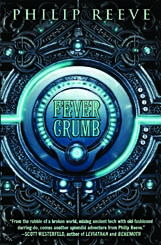
Fever Crumb by Philip Reeve‏


Fever Crumb by Philip Reeve‏Fever Crumb has been born into a futuristic world still reeling from the overthrow of the ruling Scrivens (or 'homo superior' as they like to term themselves).

This is London; but not as you know it. Commuters carry Oyster shells, instead of cards, and travel by wind tram or sudan chair. What we call modern society was destroyed by a dark period referred to as the ‘downsizing’; hence most of outer London consists of empty buildings and overgrown, useless roads. Technological advances such as flight and electricity have been lost and anyone with an interest in science is considered odd. The violence of Scriven rule is still fresh in the minds of Londoners and the city is buzzing with distrust and mutiny.

A small corner of reason remains in an abandoned monument. In a head constructed to represent the former Scriven king Auric Godshank, a band of engineers reside. Protected from the mayhem of the city they quietly beaver away at their experiments, rejecting any form of emotion as a distraction. An anomaly in a society of men, Fever Crumb was found abandoned as a baby and subsequently raised by a kind engineer named Dr Crumb.

Having been brought up in a reasonable manner, the young Fever Crumb reacts calmly when she is required to leave the engineers to assist the kooky archaeologist Kit Solvent. Solvent's rag-tag children and quirky ways baffle Fever Crumb. But that's nothing compared to the bizarre illusions Solvent's work seems to evoke in her. She's left frightened by her reaction to a visit to Godshank's former residence:

"Try the door,' said Kit, and held his lantern up to light the lock.

Weird feelings of déjà visité flooded through Fever. Memories of yesterday mingled with memories of other yesterdays which could not possibly be her own. Pain was beating again at the base of her skull. She began to wonder if she were still inside her dream. If she climbed the stairs again and went outside would there be lights in the unbroken windows of Nonesuch House?"

The city grows more and more restless as Fever begins to question her own sanity. Soon her piercing odd eyes and unusual manner evoke aggressive suspicion from Londoners. 'What are you?' is the constant refrain that Fever herself cannot answer. Why does she appear to have memories that she doesn't own? What is Kit Solvent hiding from her? And can he keep her safe from the unruly and angry crowds?

                                                  ************************************

This was my first Philip Reeve read, but I’m certain it won’t be my last. I really admire his ability to create such quirky, intriguing scenarios and characters. He plays with your familiarity of London with places names such as ‘Hampster Heath’, ‘B@ersea’, and ‘Eefrow’ and hints at religious legends involving the worship of prophets such as ‘some old-world prophet, ‘Hari, Hari! Hari Potter!’Such details make up part of the intricate world that Reeve has created. Reeve shows a delightful interest in building the world of this Mortal Engines series, layer by realistic layer. Without having to take in much detail, as the novel plays out you naturally absorb a sense of the workings of the setting.

Fever Crumb, Dr Crumb and Kit Solent are all fresh, likeable and fleshy characters with believable quirks and motivations. The dialogue moves the plot along and also provides countless moments of humour. I especially loved how the pantomime-like villain Ted Swiney was drawn:

"Ted Swiney suddenly reached across the bar and lifted him up by his coat collar. His amiable act had ended. He growled softly into Charley’s ear. ‘Anything the old cloot finds, I want to hear about it. You understand?’

Charley nodded eagerly, and Ted dumped him on the floor, grinning round at his customers to show he’d just been having a bit of harmless fun with the boy. His smiling cheeks were red and round as two wax apples. He leaned over the bar to straighten Charley’s coat and pat his hair flat. ‘Now hop along. Don’t keep Master Creech waiting."


Clearly a lover of language, Reeve has created for characters such as ted Swiney a winsome fusion between cockney and 21st century text-speak. In short, this is a multifaceted, fast-paced, charming novel that has plenty to tempt older readers, young adults and the young-at-heart.

11 September 2012

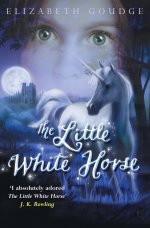
The Little White Horse by Elizabeth Goudge


The Little White Horse by Elizabeth Goudge

13-year-old Maria Merryweather has an uncanny knack for making friends. Almost everyone she meets in this old-fashioned tale falls for her frank and cheerful nature and boundless energy. Uprooted from her luxurious London home after her father's death, Maria, her governess and their pampered pooch are forced to seek refuge with her strange, distant relative Sir Benjamin Merryweather on the windbeaten coast of the West Country. Despite her faults (she's headstrong, argumentative and vain), Maria's charm soon sees her surrounded by a protective circle of adult and animal guardians. It's well she is, as the magical residence of Moonacre is not as idyllic as it first appears.

Maria soon begins to unweave the secrets of Sir Benjamin Merryweather's picturesque residence. But the facts of the past still evade her. How did her childhood friend Robin come to be here? Who was the mysterious woman that last slept in her room and rode her horse? Who are the dark men that stalk the nearby wood and deny the village access to the sea?

Published in 1946 and set in 1842, The Little White Horse merges legend, magic and adventure with old-fashioned morals and lashing of afternoon tea. The folklore influence and the inclusion of eccentric characters such as the ferocious chef Marmaduke and his all knowing, literate cat Zachariah, add to the offbeat feel of the book. Despite this originality, Elizabeth Goudge‏'s description of the landscape, the village and Maria's interactions with her beloved friends come across as a trifle twee. The benevolent Old Parson springs to mind, instated in his picture-perfect cottage, tending lovingly to his flock. Helpfully, after each Sunday service the Vicar stands at the door of the church ready to reveal and reprimand each villager's sins. It's hard to tell how a 1940's child would read this but it struck me as overtly sanctimonious and judgmental.

 Despite Maria's strong influence over the residents of Moonacre, she's often scolded for not acting as submissive as her gender dictates. It's incredibly frustrating to read! Seen through a modern day lens, Maria's childish brand of feminism grates - especially as she's considered old enough to marry. The implication seems to be that girls, women and brides should be suspended in a state of ignorant innocence. The Old Parson vehemently enforces this view whilst holding Maria in a 'grip of steel'. He advises, 'excessive female curiosity is not to be commended either. Nip it in the bud, my dear, while there is time.' Whilst it could be argued that Elizabeth Goudge‏ is accurately representing 1800 opinions, this view of femininity is repeated often enough as to be deliberate.

That all being said, Maria is ultimately a decisive, outgoing character. Her natural curiosity, sense of humour and passionate temper keep her from coming across as sanctimonious. In The Little White Horse Elizabeth Goudge has created a beguiling set of characters, and set them in a charming, idyllic English countryside with an intriguing and magical plot.